
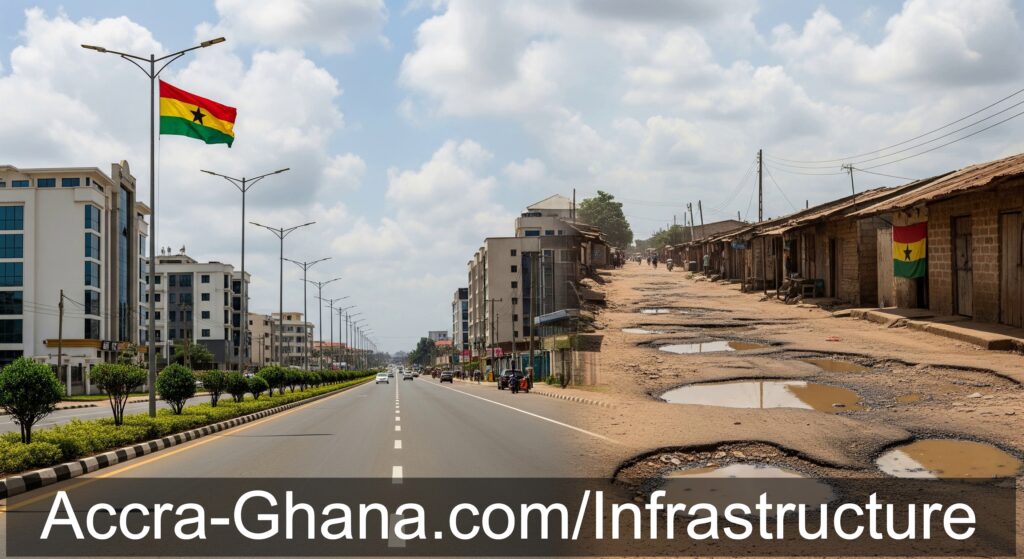
Infrastructure in Ghana shapes economic growth, urban living, and national competitiveness across West Africa. Roads, railways, ports, airports, energy systems, water supply, sanitation networks, housing, and digital connectivity determine how businesses operate and how citizens move, work, and thrive daily. While new highways, interchanges, and modernization projects show progress, persistent challenges like traffic congestion, flooding, unreliable utilities, and rapid urbanization continue to strain cities, especially Accra. Understanding Ghana’s infrastructure landscape is essential for investors, policymakers, and residents seeking sustainable development, improved productivity, and better quality of life in one of Africa’s fastest-growing economies.
Ghana’s Infrastructure Crisis: Roads, Houses, and Factories Crumbling
Infrastructure in Ghana is supposed to be the backbone of national growth, the foundation that connects cities, powers industries, and gives citizens a decent quality of life. Yet, after almost seventy years of independence, the reality is a country where roads crumble within months, houses decay, electricity falters, and drainage systems fail every rainy season. The tragedy is not the lack of money or foreign help; Ghana has hired Chinese, Indian, and European engineers to build its roads, ports, and bridges. The real issue lies in the culture—or lack thereof—of infrastructure. Maintenance is foreign to the Ghanaian mindset. In nearly every Ghanaian language, there is no proper word for maintenance. Without daily care, monitoring, and repair, the best projects fall apart within a few years, leaving citizens to navigate chaos while governments claim progress.
Half-Baked Infrastructure for the Privileged Few
Even when Ghana manages to build infrastructure, it is almost always half-baked, limited to select areas, and designed to benefit only a privileged minority. Cities like Accra are peppered with gated communities, luxury apartments, and private developments that have reliable electricity, water, and sanitation. But outside the walls, ordinary Ghanaians endure shanty settlements, pothole-filled streets, clogged drains, and unreliable utilities. The infrastructure of the rich thrives while the majority is left with fragmented systems and broken promises. This is not a coincidence but a reflection of societal priorities and political incentives. Governments chase projects that bring prestige or attract foreign investment rather than building infrastructure that works for the masses. The irony is that Ghana has the resources, the engineers, and the financial backing to do much better, yet the system consistently chooses short-term optics over long-term function.
Learning Infrastructure Abroad: Lessons from Europe
Having lived and worked in Europe, and having spent years in IT engineering, I know what infrastructure is supposed to feel like. In the Netherlands, where I now live, cities are designed as functioning ecosystems, not isolated islands of convenience. Communities are built with foresight: housing, health facilities, schools, public transport, sewage systems, electricity, and parks are integrated so that daily life runs smoothly. Maintenance is routine, proactive, and considered as essential as brushing your teeth. Roads are repaved before they crumble, drainage is cleared before floods hit, and public facilities are continuously improved. The contrast is staggering. In Ghana, infrastructure is often an afterthought, constructed, left to decay, and only superficially repaired when visible collapse embarrasses politicians. Without proper exposure, most Ghanaians cannot even imagine what functional infrastructure looks like, let alone understand how to maintain it.
Housing Infrastructure in Ghana: Luxury Islands vs. Majority Struggle
Housing infrastructure in Ghana is a perfect microcosm of the national failure. Developers focus on high-end gated communities for wealthy individuals, expats, NGOs, and the diaspora. Prices in these enclaves are astronomically high, ranging from $150,000 to over $500,000 for a single house, making them unattainable for the average Ghanaian. These developments have proper electricity, running water, sewage systems, and roads, but they are exclusive islands. Outside these walls, ordinary neighborhoods crumble. Streets are eroded, public lighting is inconsistent, water is unreliable, and sanitation systems are barely functional. Even if the government or private developers try to build housing for the middle or low-income majority, projects are often poorly planned, inadequately maintained, or left incomplete. The result is a country where basic infrastructure is a luxury rather than a right.
Maintenance Culture: The Missing Link
The absence of maintenance culture is perhaps Ghana’s most crippling flaw. Infrastructure is not just built; it must be nurtured, monitored, and managed constantly. In Ghana, once construction is completed, responsibility often evaporates into bureaucracy, apathy, or corruption. Roads crack, drainage fills with debris, and buildings degrade because no one is trained or willing to keep them operational. Foreign contractors may come, build expertly, and leave, but within a few years, decay sets in. It is not incompetence; it is a cultural disconnect. Without daily engagement and ownership, the best structures cannot survive. Even basic repairs are delayed or ignored, and what should be a minor intervention becomes a catastrophic failure. This is why infrastructure in Ghana never reaches its potential, despite decades of investment and foreign assistance.
Fragmented Planning: Why Cities Fail
Ghana also fails because infrastructure development is fragmented and unequal. Proper urban planning requires thinking in terms of whole communities, not isolated structures. In cities like Amsterdam, and The Hague in the Netherlands, small functional neighborhoods can be scaled into districts, municipalities, and cities, each designed as a self-sustaining ecosystem. Housing, transport, health services, parks, and commercial zones are integrated to ensure residents can live without daily struggle. In Accra, by contrast, infrastructure is piecemeal. Luxury gated communities exist alongside neighborhoods with eroded roads and broken electricity. Investments are concentrated where the wealthy reside, while ordinary citizens are forced to survive amidst decay. This selective approach ensures that infrastructure never serves the majority, cementing inequality and social frustration.
Governance and Political Incentives: The Cycle of Decay
The failure to build functional infrastructure after almost seventy years is also tied to governance and political incentives. Projects are often started with fanfare, but when governments change, priorities shift. Roads, bridges, or housing developments may be abandoned or redesigned to erase credit from previous administrations. Maintenance budgets are neglected because repairing old projects does not win votes in the short term. Corruption siphons funds meant for quality construction and upkeep. Bureaucracy slows implementation, and weak enforcement of planning laws allows shanties and informal settlements to undermine urban systems. Even when Ghanaians have the knowledge and resources, these structural inefficiencies prevent lasting infrastructure from emerging.
Conclusion and Reminder: Infrastructure Without Culture is Useless
Ultimately, Ghana’s infrastructure problem is not simply a technical challenge—it is a reflection of culture, governance, and societal priorities. Without a maintenance mindset, without equitable planning, and without exposure to functional systems, infrastructure will continue to crumble. Roads, housing, energy, and sanitation will fail, no matter how many Chinese engineers are hired or foreign funds are spent. Decades of half-baked projects have created a nation where the wealthy enjoy functioning infrastructure while the majority endures chaos. Until Ghana cultivates a culture that values maintenance, equality, and long-term planning, the country will remain trapped in a cycle of decay, imitation, and unfulfilled potential. Real infrastructure is not just built; it is lived in, cared for, and continuously improved, and for now, that reality remains mostly foreign to the Ghanaian experience.