
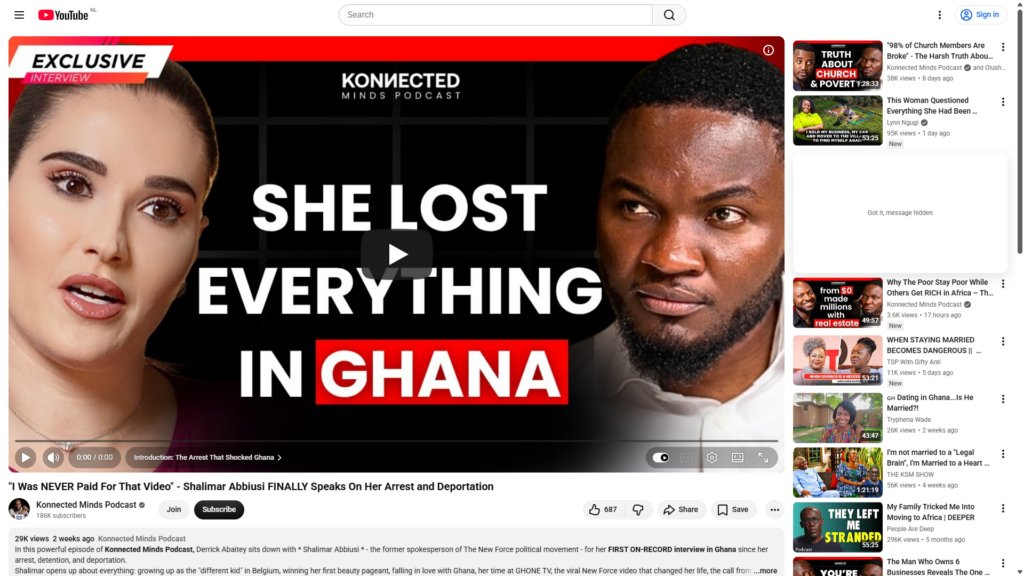
Whenever I come across a political controversy in Ghana involving foreigners, power, influence, and unanswered questions, I pay close attention because these stories often reveal more about Ghana than the people at the center of them. After watching Shalimar Abbiusi’s interview on Konnected Minds Podcast, I found myself reflecting not only on her personal journey but also on Ghana’s complicated relationship with politics, foreign involvement, public trust, and national identity. From her arrest and deportation to her return and reinvention, I believe this story raises important questions about power, perception, accountability, and the realities that often exist behind Ghana’s political headlines.
The Interview That Reopened Old Wounds
I recently sat down and watched the Konnected Minds Podcast interview featuring Shalimar Abbiusi, the former spokesperson of The New Force movement in Ghana. The moment I saw the thumbnail declaring that she had lost everything in Ghana, I knew the conversation would attract attention. Ghanaians have long memories when it comes to political controversies, especially when foreigners become part of the story. As I watched the interview, I quickly realized that this was not simply an interview about one woman. It was an interview about power, influence, politics, foreign involvement, public perception, and Ghana’s complicated relationship with outsiders who become involved in national affairs.
Ghana Has A Strange Relationship With Foreigners
One thing I have noticed over the years while writing for Accra-Ghana.com website project is that Ghanaians often embrace foreigners very quickly. The moment someone arrives in Ghana and starts praising the food, culture, hospitality, and friendliness of the people, they are welcomed with open arms. However, the moment politics enters the conversation, everything changes. Suspicion replaces excitement. Questions replace admiration. Suddenly people want to know who sent you, who funds you, who benefits from your presence, and what your true intentions are. Watching the comments under this interview reminded me that many Ghanaians still carry deep concerns about foreign influence and foreign involvement in political movements.
The Question Nobody Can Stop Asking
The biggest question hanging over the entire interview was simple. Did Shalimar really not know that The New Force was a political movement? Throughout the interview she maintained that she believed she was joining a humanitarian movement focused on empowering young people and creating opportunities. Many viewers found this difficult to accept. The New Force had already generated significant national attention. There were billboards, media discussions, public speculation, and growing curiosity about the mysterious organization. For many people watching, this explanation became the most controversial part of the entire interview. Whether one believes her or not depends largely on how much trust they place in her version of events.
The Famous Statement About Money
The title of the interview focused heavily on one statement. Shalimar repeatedly stated that she was never paid for the viral video that made her famous across Ghana. This immediately captured public attention because money often sits at the center of political controversies. Ghanaians are naturally skeptical whenever politics, influence, and public campaigns intersect. What fascinated me was how carefully every word was chosen. She did not appear emotional or reckless. She appeared calculated, composed, and very aware of how her words would be interpreted. That careful communication style explains why some viewers praised her intelligence while others remained deeply skeptical.
Ghanaian Comment Sections Are Their Own Country
Sometimes I honestly believe that Ghanaian comment sections deserve their own constitution and parliament. The reactions underneath this interview were more entertaining than some television programs. One person described her as inspirational and resilient. Another accused her of hiding important details. Some people wanted her to receive Ghanaian citizenship. Others questioned why she had returned at all. Reading through the comments felt like walking through Makola Market where every trader is selling a completely different version of the same story. The diversity of opinions revealed just how divided people remain regarding her role in one of Ghana’s most talked about political controversies.
The Political Storm That Changed Everything
There is no denying that the viral New Force video changed Shalimar’s life forever. Before that moment she was known primarily for media work, pageantry, acting, and public appearances. After the video, she became associated with one of the most controversial political movements in modern Ghanaian politics. Within days she was no longer simply a media personality. She became the center of a national debate. Arrests, detention, deportation, legal battles, and international headlines followed. Regardless of where people stand politically, it is difficult to deny that the experience completely transformed her public image and permanently connected her name to Ghana’s political history.
Why Her Return To Ghana Is So Fascinating
The part of the interview that surprised me most was not her arrest or deportation. It was her decision to return. Most people who experience such public controversy in a foreign country would probably choose to stay away. Yet she repeatedly described Ghana as home and insisted that she still felt connected to the country. That decision says something important. Either her attachment to Ghana runs much deeper than critics realize, or she believes her future opportunities remain closely tied to the continent. Perhaps it is a combination of both. Whatever the reason, her return demonstrates that her relationship with Ghana remains far from over.
The Transformation That Raised Eyebrows
Another aspect of the interview that generated discussion was her career transformation. According to her account, she moved from biomedical science into media, then into humanitarian work, and eventually into diplomatic advisory roles connected to projects across Africa. Supporters view this as evidence of resilience and personal growth. Critics view it as a transformation that requires more explanation. This divide was visible throughout the comments section. Some viewers celebrated her achievements while others questioned how such rapid changes occurred. Regardless of which side people choose, there is no denying that her journey has been highly unusual.
Lessons Every Foreigner In Ghana Should Learn
One lesson I took away from this interview is that Ghana can be both welcoming and unforgiving at the same time. Foreigners who come to Ghana often fall in love with the warmth, culture, and opportunities. However, politics operates according to a completely different set of rules. Anyone entering political spaces must understand exactly what they are joining and who they are dealing with. Influence can disappear overnight. Allies can become silent. Public opinion can shift rapidly. The Shalimar story serves as a reminder that visibility and popularity do not automatically translate into protection when controversy arrives.
Why This Story Still Matters Today
As I finished watching the interview, I realized that the story continues to matter because it reflects larger questions about Ghana itself. It raises questions about power, foreign influence, accountability, political movements, public trust, and national identity. Some viewers walked away inspired by her resilience. Others walked away more skeptical than ever. I suspect the truth lies somewhere between those two positions. What is certain is that Shalimar Abbiusi remains one of the most fascinating and controversial figures connected to recent Ghanaian political history. Years from now, people will still be debating what really happened, who knew what, and how a foreign media personality became one of the most talked about names in Ghana’s modern political drama.