
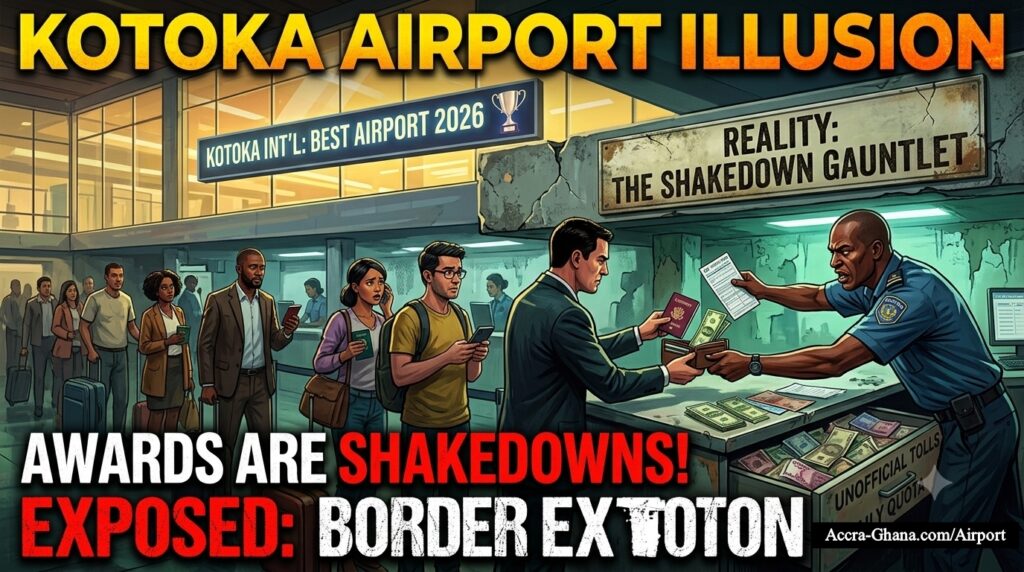
Kotoka International Airport wins glowing efficiency awards, yet returning travelers face a predatory gauntlet of border extortion. Behind polished glass and high-tech biometric gates lies a shadow economy where low-tech bribery thrives. Returning citizens and international investors are treated like ATMs, dismantling the promise of a seamless homecoming. Systemic bribery at border checkpoints harms national progress and scares off essential investment. Explore the true cost of airport corruption and discover practical strategies to navigate the terminal, document extortion, and protect your return to Ghana.
Problem at Airport in Ghana
1) The Cruel Joke Of 2026 Infrastructure Accolades
The year 2026 arrived with a flurry of gleaming press releases and gold plated certificates; Kotoka International Airport stood at the center of this manufactured glory, collecting global awards for efficiency like they were simple participation trophies. For the traveler arriving from abrokyire, the polished glass and shimmering terminals are nothing more than a sophisticated trap designed to lull the weary into a false sense of security. These recent infrastructure accolades feel like a cruel joke when contrasted with the visceral frustration of the people actually moving through the gates. The facade of modern progress is thick; however, it cannot mask the predatory smell of a system designed to extract wealth rather than facilitate movement. You walk through a terminal that looks like the future, yet you are met with a level of primitive extortion that belongs in a bygone era. The plaques on the wall claim excellence, but the eyes of the officials suggest a much different agenda involving your wallet. This is the great Ghanaian paradox: we build cathedrals of glass only to staff them with people who treat your arrival like a harvest season for their personal bank accounts. The awards are mere ornaments on a tomb of integrity.
2) The High Tech Biometric Smokescreen Behind The Glass
Digital transformation is the favorite buzzword of the administrative class in Accra. We are told that sophisticated biometric gates and automated systems have revolutionized the entry process, making it seamless and modern for every fine boy or girl landing from London or New York. However, this high tech infrastructure serves as a convenient smokescreen for the low tech bribery that remains the true engine of the airport. Automation is supposed to remove the human element of corruption; yet, the humans at Kotoka have found ways to insert themselves back into the digital flow with alarming creativity. It is a profound irony to watch a traveler pass through a million dollar face scanner only to be stopped seconds later by an official requesting a dash for water. This digital transformation is a performance; it is a manual extortion economy dressed in the expensive robes of silicon and software. The machines work perfectly, but the system around them is designed to fail so that the human hand can reach out for a tip. We are witnessing the marriage of the fourth industrial revolution and a medieval toll booth.
3) The Anatomy Of The Pocket Money Request
The transition from the high tech gate to the low tech hand out is a jarring experience for any returning citizen. You move from the sterile environment of automated security into the warm, sweaty embrace of the anything for the boys culture. This is the moment where the efficiency narrative dies a quiet and painful death. The request for pocket money is rarely a demand; it is a suggestion, a lingering look, or a deliberate slowing of a process that should take seconds. Officials use active, vivid gestures to signal their expectations, leaning over counters and lowering their voices to create an atmosphere of informal intimacy that feels entirely predatory. They treat the traveler not as a customer, but as a benefactor who has arrived to solve their personal financial problems for the day. This exchange is the heartbeat of the terminal, a professionalized system of begging that turns a professional border crossing into a marketplace of petty transactions. It is the ultimate degradation of the Ghanaian welcome.
4) The Invisible Taxes On Your Suitcase
Routine luggage inspections at Kotoka are rarely about safety or customs compliance; instead, they have been weaponized as invisible taxes that specifically target the diaspora. Every suitcase is viewed as a treasure chest, and every traveler is seen as a mobile bank account waiting to be emptied by the greedy. The source context is quite clear about this predatory mindset:
Kotoka International Airport wins global awards for efficiency, but for those landing today in 2026, the 'Best Airport' plaques feel like a cruel joke. Behind the polished glass and automated gates lies a predatory system where travelers are treated like ATMs.
These inspections are the tools of the trade; officials sift through personal belongings not to find contraband, but to find leverage for a shakedown. They look for items they can claim are restricted or subject to high duties, using the threat of seizure to prompt a private settlement. It is a calculated strike against the people who are bringing resources back to the country. If you have chocolate or perfumes, you are effectively paying a luxury tax directly into a pocket rather than a treasury.
5) Psychological Warfare At The Border Checkpoint
The officials at the border checkpoints are masters of psychological tactics; they understand that for a traveler who has just spent twelve hours on a plane, time is the most valuable commodity. By creating artificial delays, they turn the clock into a lever to pressure individuals into paying for their own freedom of movement. They might stare at a perfectly valid passport for an uncomfortable amount of time or pretend that the digital system is lagging with a heavy sigh. They create a state of limbo where the traveler feels trapped and uncertain in a foreign yet familiar land. The goal is to make the passenger so desperate to leave the airport that they will pay any amount of money just to escape the terminal and the stifling gaze of the uniformed. This is not service; it is a form of soft kidnapping where the ransom is a few bills slipped between the pages of a yellow fever card. They bank on your fatigue to finance their lunch.
6) The Human ATM: Diaspora As A Cash Crop
There is a predatory mindset within the airport walls that views returning citizens not as family or fellow countrymen, but as financial targets to be harvested. The diaspora is treated as a cash crop; their arrival is the season for chopping and their bags are the silos of wealth. This specific demographic is chosen for the heaviest extortion because they are perceived to have deep pockets and a lack of local knowledge regarding current regulations. They are also less likely to cause a public scene, as they often just want to get to their final destination to see their families and eat some real home cooking. This exploitation of the homecoming sentiment is particularly cynical and heartless. The very people the government claims to want to attract for investment are the ones being bled dry at the gateway. It turns the entire concept of the return into a financial gauntlet where the price of entry is constant harassment.
7) The Year Of Return Legacy In Shambles
The government PR machine spent years building the Year of Return as a brand of global welcome and Pan African unity. However, the reality of the hostile gateway has left that legacy in a state of utter shambles. There is a massive gap between the colorful welcome mat described in brochures and the open palm encountered at the luggage carousel. Use of cynical humor is almost required to describe this disconnect; one might imagine the tourism posters should be updated to show an official smiling while holding a credit card reader. The spirit of the return is being dismantled one bribe at a time by the very people wearing the national crest on their shoulders. While politicians give speeches about the importance of the diaspora, the ground staff are busy ensuring that the first experience any returnee has is one of being cheated. It is a strategic failure that undoes millions of dollars in international marketing. The welcome mat is actually a trap door.
8) The Shadow Economy Of Border Quotas
Behind the scenes, the shakedown is not a series of random acts; it is an organized shadow economy with its own informal hierarchies and daily collection quotas. Ground staff operate within a professionalized system of rot where everyone has a role to play in the grand scheme. There are lookouts who identify high value targets and collectors who handle the actual transactions with practiced ease. This is not just a few bad apples looking for lunch money; it is a structured enterprise where the proceeds are often shared up the chain of command to buy silence. The anatomy of the shakedown reveals that the efficiency of the airport is actually quite high, but only when it comes to the logistics of corruption. They have mastered the art of moving money from the pockets of travelers to the pockets of the staff with the precision of a Swiss watch. It is the most functional department in the entire Ministry of Transport.
9) Why High Tech Gates Can Not Fix Low Tech Greed
We must accept that technology is entirely useless without systemic integrity; you can install the most advanced surveillance systems in the world, but if the people monitoring the cameras are in on the take, the system is a total failure. The high tech gates cannot fix the low tech greed that defines the human interactions at Kotoka. Surveillance systems often suffer from convenient blind spots or technical glitches exactly when an extortion attempt is taking place between an officer and a victim. This is a choice, not a bug; the failure to catch ground level bribery is an indication that the leadership is not interested in stopping the practice. Without a fundamental change in the culture of the institution, no amount of hardware will ever secure the border from the people who are paid to protect it. Greed is a human problem that requires a human solution; software cannot code out the desire for an unearned buck.
10) The Economic Cost Of A Bad First Impression
The economic sabotage occurring at the gate has a measurable impact on the nation that goes beyond petty theft. We can quantify the rot: every twenty dollar dash requested for a luggage check represents an informal tax of approximately five hundred percent on the perceived value of a second hand laptop or a box of chocolates. These tolls discourage small scale trade and the repatriation of resources by the diaspora who simply decide the hassle is not worth the effort. When a person knows they will be harassed and taxed informally for every item in their suitcase, they simply stop bringing items home to start small businesses. They stop carrying electronics for their relatives or supplies for local clinics. This represents a significant drain on national productivity; the airport should be a conduit for wealth, but it has become a bottleneck of greed. The short term gain of the official is a long term loss for the country.
11) Foreign Direct Investment Versus The Airport Gauntlet
Predatory behavior at the point of entry is the fastest way to scare off international investors who are looking for stability and transparency. An investor arriving in Ghana for the first time is looking for signs of the rule of law; when they are met with a gauntlet of extortion before they even leave the terminal, they receive a very clear message about the cost of doing business in the country. The airport acts as a literal gatekeeper of national progress; if the gateway is corrupt, the investor assumes the entire house is in the same state of decay. This first impression is often the last impression they will ever have of our republic. No amount of tax incentives or investment summits can overcome the damage done by an official asking for a bribe at the immigration desk. The airport is currently working against the national interest by signaling that Ghana is a place where everything has a hidden and illicit price.
12) The Stench Of See No Evil Management
The role of airport management in this crisis cannot be ignored; there is a palpable stench of see no evil leadership that prioritizes smooth optics and global plaques over the reality of traveler reports. Leadership seems to be more concerned with chasing awards than with the integrity of their staff on the floor. When viral footage of traveler frustration surfaces, the response from the plaque chasing bureaucrats is usually defensive rather than investigative. This management style creates a culture of impunity; if the people at the top are satisfied with the awards, the people at the bottom feel free to continue their predatory schemes. The disconnect between the executive offices and the arrivals hall is vast and widening. Management is essentially complicit in the extortion by failing to implement the radical transparency required to stop it. They prefer the illusion of excellence to the hard work of actual reform.
13) The Disconnect Between PR And The Lived Experience
There is a massive gulf between the official government PR narrative of a seamless entry and the actual lived experience of those moving through Kotoka daily. The state sponsored myths tell a story of a modern, welcoming gateway that is the envy of the continent; meanwhile, the internet is flooded with viral footage and testimonies of people being hounded for cash. This disconnect is a form of institutional gaslighting; travelers are told that they are experiencing world class service while they are being actively exploited. The reality of the hostile gateway is well documented by the victims, yet the official response remains stuck in a loop of denial and deflection. This gap in the narrative undermines the credibility of the entire state; if they can lie about something as visible as the airport experience, what else are they lying about regarding our national development?
14) The Ghost Of Efficiency Awards Past
The efficiency plaques hanging on the walls of the terminal should be viewed as ghosts of a credibility that never truly existed. They are cruel jokes that serve only to mock the people being shook down in their very shadows. These awards are often based on technical metrics like plane turnaround times or baggage handling speed, which completely ignore the human experience of extortion and harassment. A plane can land on time and bags can arrive quickly; however, if the passenger is harassed for thirty minutes by a customs officer for pocket money, the airport is a spectacular failure. These plaques are the participation trophies of a declining institution; they provide a false sense of accomplishment for a management team that has lost touch with the ground level reality. True efficiency must include the integrity of the process, not just the speed of the heavy machinery.
15) Institutional Failure As A National Identity
The humbling reality of the gateway at Kotoka reflects a wider institutional decay that has begun to define the national identity in the eyes of the world. When the literal entry point to the country is defined by lawlessness and predatory behavior, it suggests that the rot goes all the way to the core of our governance. This is not just about an airport; it is about a total breakdown in the social contract between the state and its people. The airport is the first place where the state exercises its power over the individual, and the fact that this power is used for extortion is a chilling indicator of the health of our republic. This institutional failure bridges the gap between infrastructure problems and national productivity. If you cannot manage a single terminal without systemic bribery, you cannot manage a modern economy in a competitive global landscape.
16) The Fear Of The Blacklist: Why Travelers Stay Silent
One of the most effective tools in the arsenal of the corrupt official is the lack of anonymous whistleblowing channels. Travelers often stay silent about their experiences because they fear retaliation or being placed on an informal blacklist that complicates future visits. There is a psychological fear that if you report an official, your name will be flagged, and your next entry into the country will be even more difficult and expensive. This fear keeps the diaspora compliant and ensures that the cycle of extortion continues without interruption. People would rather pay twenty dollars and get home to their families than risk being held in a back room for hours or having their documents scrutinized by a vengeful clerk. This silence is the oxygen that the system needs to survive; without a safe and truly anonymous way to report these crimes, the officials remain untouchable targets.
17) Dismantling The State Sponsored Myths Of Seamless Entry
It is time to engage in a direct counter narrative strategy to dismantle the state sponsored myths surrounding Kotoka once and for all. The first myth is that the airport is a welcoming gateway; in reality, it is a hostile environment for anyone perceived to have money in their pockets. The second myth is that technology has solved the problem of corruption; in reality, technology has only provided a cleaner facade for the same old schemes of the past. The third myth is that the efficiency awards mean the airport is functioning well; in reality, these awards are PR tools used to distract from systemic rot. We must call out these myths specifically and loudly at every opportunity. The state uses these narratives to maintain the flow of international aid and investment, but the truth is found on the ground in the arrivals hall. Dismantling these myths is the first step toward actual reform.
18) The Art Of The Artificial Delay In The Arrivals Hall
The gauntlet of extortion is built on the art of the artificial delay; this is the physical experience of being held in a limbo state where nothing is happening, yet you are not allowed to move forward. An official might take your passport and simply set it down while they engage in a conversation with a colleague about their weekend plans. They might move your luggage to a separate area and tell you to wait without explaining why or for how long. These moments are designed to test your patience and your wallet until you break. They are waiting for you to ask how you can speed up the process; once that question is asked, the price of your freedom is set. This is a highly choreographed performance of power. The delay is not caused by a system error or a lack of staff; it is a deliberate tactic used to break the will of the traveler.
19) Digital Eyes That Blink For Cash: Surveillance Blind Spots
The failure of surveillance systems at Kotoka is an intentional strategy rather than a technical limitation of the hardware. Dark humor suggests that the cameras are only fully functional when no one is getting paid or when a VIP is walking through the hall. In a modern facility, there should not be a single square inch of the arrivals process that is not recorded and monitored by an independent body. However, the current setup allows for private conversations in corners and unmonitored exchanges at the luggage belt where the real chopping happens. These blind spots are preserved to allow the shadow economy to thrive without fear of evidence. If management truly wanted to stop the shakedown, they would ensure that every interaction between an official and a passenger was recorded with audio and video. The fact that this has not happened proves that the blind spots are a feature.
20) From Permission Culture To Service Culture
To fix the gateway, there must be a fundamental shift from a culture of permission to a culture of service. Currently, the officials at Kotoka act as if they are granting you a personal favor by allowing you to enter the country of your birth. They view their position as one of power to be leveraged for personal gain rather than a duty to the public. A service culture would mean that the official understands their role is to facilitate the traveler’s journey as quickly and professionally as possible. This requires a total overhaul of the training and incentives within the border agencies. They must be taught that the traveler is a customer who pays their salary through taxes and fees. Until the staff sees themselves as service providers rather than gatekeepers, the predatory mindset will persist. The transition from demanding a bribe to providing a service is vital.
21) The Digital Only Roadmap For Survival
A key strategy for eliminating bribery is the implementation of a digital only roadmap for all interactions at the airport. This means removing the physical opportunity for an official to ask for pocket money or a dash. Every fee, every fine, and every duty should be paid through a centralized digital platform before the traveler even arrives at the desk. There should be no cash handled at any checkpoint under any circumstances. If an official claims there is a problem with a document, the resolution should be handled through a digital appeal process rather than a one on one conversation in a dark corner. By removing the physical interaction, you remove the leverage that officials use to extort money. This is the only way to bypass the human element of greed that has corrupted the current system. Survival of the airport depends on this total digitization.
22) The Heavy Price Of National Progress
The nation pays a heavy price for the corruption at its primary gateway; this is not just about a few dollars lost to a dishonest official. We are looking at a massive drain on national productivity; let us call it the gatekeeper tax. If we calculate the time lost to artificial delays, it represents thousands of man hours per month that could be spent on actual economic activity. Furthermore, the informal tolls act as a one hundred percent deterrent for many small scale investors who see the airport as a harbinger of the bureaucracy they will face in the country. This is a form of economic treason. When the gateway to a nation is a place of extortion, the nation itself is held back from its potential. We are trading our national future for the short term enrichment of a few border guards.
23) Survival Intelligence For The Returning Investor: A Field Guide
For the international investor or the returning citizen, navigating the airport requires a specific kind of survival intelligence. You must enter the terminal with a mindset of firm, polite resistance at all times. Do not offer tips or pocket money for services that are part of the official’s job; instead, maintain eye contact and keep your posture confident. Keep your documents in order and be prepared to wait out the artificial delays with a smile and a book. If an official suggests a private settlement, ask for an official receipt and the name of their supervisor immediately. This often causes the official to back down, as they do not want to leave a paper trail of their misdeeds. Knowledge of the actual rules is your best defense against the financial gatekeepers who bank on your ignorance. Carrying yourself with an air of informed confidence is your shield.
24) Recording The Rot: Strategies For Accountability
The most powerful tool for dismantling the system of extortion is the smartphone in your pocket. We must empower travelers with specific strategies to record and report these attempts safely and effectively. Use your phone to document the time, the location, and the name on the official’s badge the moment things feel wrong. If you feel an extortion attempt is beginning, start recording audio discreetly; many apps allow for background recording that does not reveal you are documenting the conversation. This data is the only thing that can break the see no evil management style that protects the corrupt. When there is undeniable proof of corruption, the authorities are forced to act to save their own reputations. Recording the rot is a service to the nation and a necessary step in cleaning up the gateway. Your phone is a weapon for accountability.
25) The Tarnished Gateway: A Literal and Figurative Failure
Kotoka International Airport is both a literal and a figurative failure of our national ambition. Physically, it is a place where the movement of people is hindered by greed; figuratively, it represents the gap between what Ghana claims to be and what it actually is today. It is the tarnished gateway of a nation that is struggling to live up to its own potential because of internal decay. The failure of the airport is a failure of Ghanaian hospitality; we pride ourselves on being a welcoming people, yet we allow our visitors to be harassed at the front door. This reality is a stain on the national character that no award can wash away. If the gateway is broken, the entire house is compromised. We must reflect on what this means for our future and whether we are willing to accept this level of rot.
26) The Myth Of The Seamless Homecoming
The phrase seamless entry is a hollow slogan that bears no resemblance to the truth of the Ghanaian experience. The investigative teaser for any story about Kotoka should focus on the reality behind this corporate speak; the homecoming is actually a jagged and uncomfortable experience. It is defined by the constant fear of being targeted for a bribe by a uniformed official. The government uses the word seamless to describe a process that is actually designed to be as difficult as possible to encourage the payment of grease money. We must deconstruct this language and expose it for the PR lie that it is. A true homecoming would be one where the traveler feels safe, respected, and valued from the moment they land. At Kotoka, the traveler feels like a target in a gauntlet. The myth of the seamless return is a marketing tool.
27) The Call For Systemic Integrity Over Plaque Chasing
It is time to demand that airport management focus on ground level reality instead of global awards and hollow accolades. This award chasing culture is a distraction from the fundamental task of running a clean and efficient border for the people. We should mock the management for their pride in plaques that are essentially meaningless to the average traveler being shook down. Systemic integrity is much harder to achieve than a high score on a rigged efficiency metric, but it is the only thing that matters in the long run. We need a leadership team that is willing to fire corrupt officials, install total surveillance, and move to a digital only system without hesitation. Until they are willing to do the hard work of reform, the awards they win are nothing more than decorations in a house of rot. Integrity must be the metric.
28) A Hostile Gateway That Penalizes Progress
The airport has become a bottleneck that penalizes the very progress the country needs to survive in the modern world. It is a hostile gateway that treats the most valuable visitors as the biggest threats to the system’s illicit income. By making the entry process difficult, the airport staff are effectively sabotaging the national economy for their own benefit. They are slowing down the flow of people and resources that are necessary for growth and development. This is a form of institutional treason that should be treated with the utmost seriousness. When the gateway to a nation is a place of extortion, the nation itself is held back from reaching its true potential. The hostility of the gateway is a direct threat to the prosperity of every Ghanaian, whether they travel or not.
29) The Roadmap To A New Kotoka
The roadmap for reform is clear; however, it requires political will and a massive shift in institutional culture. First, we must eliminate the physical interaction between travelers and officials for all financial matters. Second, we must implement a culture of accountability where staff are monitored and penalized for predatory behavior without exception. Third, we must create a truly anonymous and effective system for reporting extortion that protects the traveler from retaliation. This shift from a culture of permission to a culture of service is the only way to save the reputation of the airport and the country. We need a gateway that reflects the best of our country, not the worst of our greed. The roadmap to a new Kotoka is built on transparency, technology, and a commitment to integrity that goes beyond plaques.
30) The Final Ponder: Is Ghana Actually Open For Business?
As we conclude this analysis, we must ask the final and most uncomfortable question: Is Ghana actually open for business, or is it just open for a shakedown? The Year of Return was a beautiful idea; however, it cannot survive the Year of the Shakedown. If we continue to allow our airport to be a gauntlet of extortion, we are telling the world that our hospitality is a lie. The future of our national progress depends on our ability to fix the gateway once and for all. We must decide if we want to be a nation that wins fake awards or a nation that provides real service to its people and its guests. The choice is ours, but the clock is ticking; every day the illusion of efficiency persists, the reality of our decay becomes more obvious to the world. Is the gateway open, or is it just a very expensive toll booth?
Conclusion and Reminder about Extortion in Ghana Airport
Kotoka International Airport claims global awards for modern efficiency, but arriving travelers face aggressive border extortion behind the scenes. Despite biometric gates and high-tech upgrades, border officials use artificial delays and routine bag checks to demand bribes. This systemic shakedown targets the diaspora, damages foreign direct investment, and undermines national development. The official state narrative of a seamless homecoming stands in sharp contrast to the financial gauntlet at the gates. Discover the true cost of airport corruption and learn actionable strategies to safely report extortion, resist bribery, and navigate the terminal.